
SABER OF THE MONGOL PERIOD FROM MINUSINSK HOLLOW
DOI:
https://doi.org/10.24852/2587-6112.2020.6.354.365Keywords:
archaeology, Mongol conquests, the Yenisei Kyrgyz, long-bladed weapons, sabers of the Mongol periodAbstract
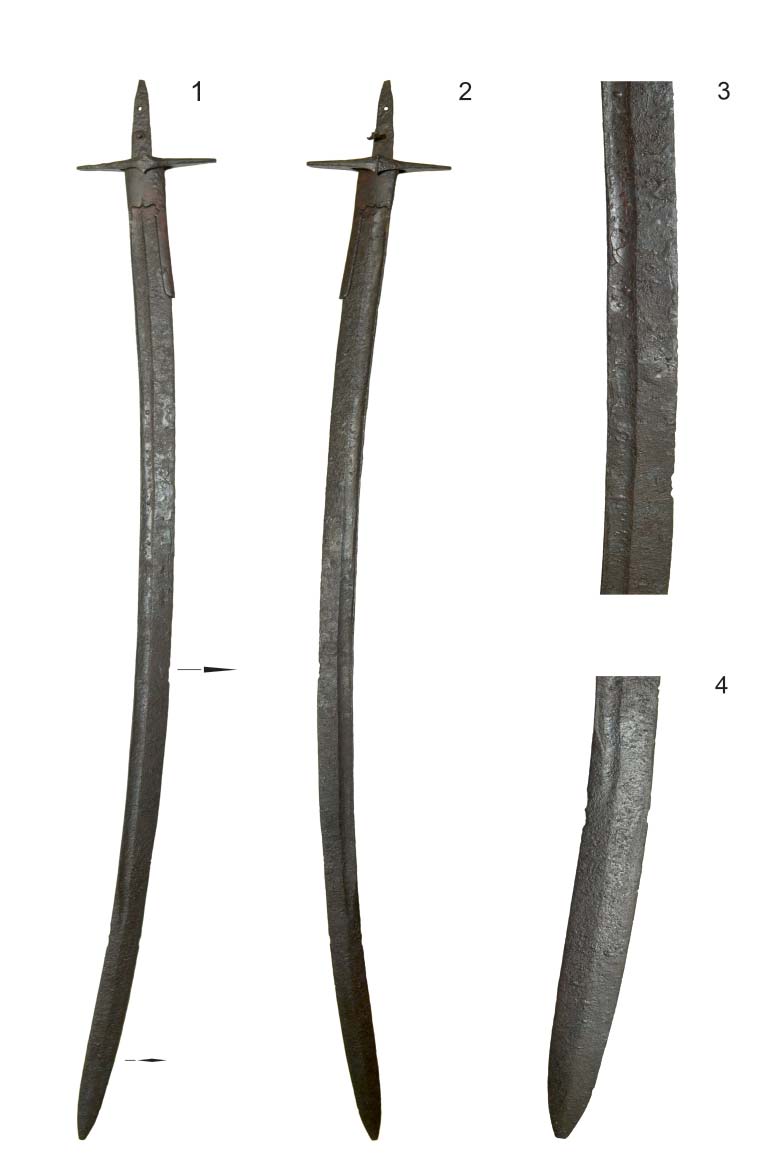
A saber constituting a random fi nd from the territory of Minusinsk Hollow was studied by the authors. It was found 30 km from the city of Minusinsk, Krasnoyarsk Oblast, Russian Federation. This saber is currently deposited in a private collection. It is equipped with an acute-angled (faceted and double-edged at the tip) blade with a wide double-sided fuller and an elongated rhombic "scaphoid" guard. The heel of the blade (ricasso) is reinforced with a fi gured cage and a long "tongue". The saber blade under the cage and "tongue" features a special slot and notches. Two holes for rivets were punched in the "shank", which were used to fasten the
"cheeks" of the handle. The rivets were fi tted with massive S-shaped heads. Based on the typological analysis, it was established by the authors that the closest counterparts of the saber originate from the territory of Southern Siberia, Kazakhstan and Eastern Europe, and date back to the 13th-14th centuries. The saber discovery site and traces of oxidation on its surface (the formation of which is possibly associated with the burial rite of cremation) suggest that the owner of the saber was a wealthy Yenisei Kyrgyz warrior.
References
Belorybkin, G. N. 2001. Zolotorevskoe poselenie (Zolotorevka Settlement). Saint Petersburg; Penza: Penza State Pedagogical University (in Russian).
Belorybkin, G. N., Gusynin, V. A., Izmailov, I. L. 2020. Vooruzhenie naseleniia yugo-zapadnoi Bulgarii (X – XIII veka) Armament of the Population of South-Western Bolgaria (10th - mid-13th centuries). Arkheologiia Evraziiskikh stepei (Archaeology of Eurasian Steppes) 1 (in Russian).
Bobrov, L. A., Kushkumbaev, A. K., Kairmagambetov, A. M., Islamov, D. 2020. In Vestnik Novosibirskogo Gosudarstvennogo universiteta. Istoriia, fi lologiya (Bulletin of the Novosibirsk State University: History, Philology) 19 (7), 245–256 (in Russian).
Bobrov, L. A., Khudyakov, Yu. S. 2008. Vooruzhenie i taktika kochevnikov Tsentral'noy Azii i Yuzhnoy Sibiri v epokhu pozdnego srednevekov'ya i rannego Novogo vremeni (XV – pervaya polovina XVIII v.). (Armament and Tactics of the Central Asian and South Siberian Nomads in the Late Middle Ages and the Early Modern Time (15th - fi rst half of 18th cc.). Saint Petersburg: Faculty of Filology, Saint Petersburg State University (in Russian).
Bobrov, L. A., Pronin, A. O. 2012. In Kul'tury stepnoi Evrazii i ikh vzaimodeistvie s drevnimi tsivilizatsiiami (Cultures of Steppe Eurasia and Their Interactions with Ancient Civilizations) 2. Saint Peterburg: Institute for the History of Material Culture, Russian Academy of Sciences; “Periferiia” Publ., 572–581 (in Russian).
Gorbunov, V. V. 2006. Voennoe delo naseleniya Altaya v III–XIV vv. Chast' I: Nastupatel’noe vooruzhenie (oruzhie) (Military Science of Altay Population in III-XIV Centuries. Part II. Offensive Armament (Weapons)). Barnaul: Altay State University (in Russian).
Gorelik, M. V. 2002. Armii mongolo-tatar X–XIV vekov. Voinskoe iskusstvo, snaryazhenie, oruzhie (Armies of the Mongol-Tatars in the 10th – 14th cc. Military Arts, Equipment and Armament). Moscow: “Vostochniy gorizont” Publ. (in Russian).
Gorelik, M. V. 2004. In Voennoe delo narodov Sibiri i Tsentralnoi Azii (Military Art of the Peoples of Siberia and Central Asia). Novosibirsk: “Nauka” Publ., 86−101 (in Russian).
Gorelik, M. V. 2008. In Vestnik Instituta gumanitarnykh issledovanii Pravitel'stva KBR i KBNC RAN (Bulletin of the Kabardian-Balkarian Institute for the Humanities Research). 15, 158–189 (in Russian).
Gorelik, M. V., Gredunov, E. V. 2014 In Istoriia zbroi. Almanakh (Нistory of weapons. The almanac) 10, С. 208–218 (in Russian).
Izmailov, I. L. 1997. Vooruzhenie i voennoe delo naseleniya Volzhskoy Bulgarii X – nachala XIII v. (Armament and Warfare of the population of Volga Bulgaria 10th – beginning of 13th century) Kazan-Magadan: North-East Scientifi c Center, Russia Academy of Sciences Far East Branch (in Russian).
Izmailov, I. L. 2008. Zashchitniki “Steny Iskandera” (Defenders of the Iskander Wall). Kazan: “Tatarskoe knizhnoe izdatel’stvo” Publ. (in Russian).
Kochkarov, U. Yu. 2008. Vooruzhenie voinov Severo-Zapadnogo Predkavkaziia VIII – XIV vv. (oruzhie blizhnego boja) The arm of the Norht-West Ciscaucasia warriors in VIII-XIV (close-in fi ghting weapons). Moscow: “Taus” Publ. (in Russian).
Myasnikov, V. Yu., Yaroslavskaya, L. G. 2017. In Teoriia i praktika arheologicheskikh issledovaniy (Theory and practice of archaeological research) 19(3), 57–68 (in Russian).
Obukhova, M. A. 2019. In Arkheologiia (Archaeology). Novosibirsk Novosibirsk State University, 79–80 (in Russian).
Skobelev, S. G., Ryumin, M. A. 2010. In Vestnik Novosibirskogo Gosudarstvennogo universiteta. Istoriia, fi lologiya (Bulletin of the Novosibirsk State University: History, Philology) 9 (7), 144–154 (in Russian).
Solov’ev, A. I. 2003. Oruzhie I dospekhi. Sibirskoe vooruzhenie: ot kamennogo veka do srednevekov’ia (Weapons and Armor. Siberian Armament: from the stone age to the middle ages). Novosibirsk: INFOLIOpress” Publ. (in Russian).
Khudyakov, Yu. S. 1980. Vooruzhenie eniseiskikh kyrgyzov (Armament of the Yenisei Kyrgyz). Novosibirsk: “Nauka” Publ. (in Russian).
Khudiakov, Yu. S. 1986. Vooruzhenie srednevekovykh kochevnikov Iuzhnoi Sibiri i Tsentral’noi Azii (Arms of the Medieval Nomads of the Sourthern Siberia and Central Asia). Novosibirsk: “Nauka” Publ. (in Russian).
Khudyakov, Yu. S. 1997. Voennoe delo kochevnikov Yuzhoi Sibiri I Tsentral’noi Azii v epokhu razvitovogo srednevekov’ia (Military Art of the Nomads of South Siberia and Central Asia in the Developed Middle Ages). Novosibirsk: Siberian Branch of the Russian Academy of Sciences, Institute for Archaeology and Ethnography (in Russian).
Shirin, Yu. V. 2002. In Gorbunov, V. V., Tishkin, A. A. (eds.). Materialy po voennoi arkheologii Altaia i sopredel'nykh territorii (Materials on the Military Archaeology of the Altai and the Neighbouring Territories). Barnaul: Altai State University Publ., 130–134 (in Russian).
Rivkin, K., Isaac, B. 2017. A Study of the Eastern Sword. Printed in Mankato. 2008. The Arts of the Muslim Knight. The Furusiyya Art Foundation Collection. Milan: Skira.
Downloads
Published
How to Cite
Issue
Section
License
Copyright (c) 2020 L. A. Bobrov, A. O. Pronin, Y. A. Filippovitch

This work is licensed under a Creative Commons Attribution-NonCommercial 4.0 International License.